TL;DR
- 85.2% vs 10.4%: Claude Sonnet 5 on SWE-bench Verified (2026-06-30) against the frontier ceiling on Harvey's Legal Agent Benchmark (2026-05-28). Same model tier, five weeks apart. That gap is not capability — it is who grades the work.
- Software got agents first because software is the only domain whose work comes with a free grader: compiler, tests, CI, diff. Everything else is downstream of that one fact.
- The popular four-preconditions story is one law with three multipliers. The law is machine-checkable ground truth. The multipliers — versioned artifacts, composable tools, practitioner-builders — only compound because the law is free.
- The enterprise question is not which domain is 'ready' for agents. It is what your domain's compiler is going to be, who is going to build it, and how you will price the work once verification is cheap.
Two numbers.
85.2%. Claude Sonnet 5, released 2026-06-30, on SWE-bench Verified. Machine-graded. Independent replication in Artificial Analysis. The problem shows up as a GitHub issue in a real Python repo. The agent proposes a patch. A test suite runs. The score is a diff and a pass count. No human required.
10.4%. Opus 4.8, released 2026-05-28, on the Harvey Legal Agent Benchmark. Human-graded. The problem shows up as a legal task — draft a memo, negotiate a clause, resolve a discovery request. The score is a rubric filled in by lawyers. Ten point four percent all-pass was the first time any frontier model broke double digits on that benchmark.
Same tier of models. Within five weeks of each other. Same silicon, same base capability under the hood.
Everyone reading those two numbers wants to make them a story about software engineering being special, or about law being harder, or about lawyers being slower to adopt. None of that is the story.
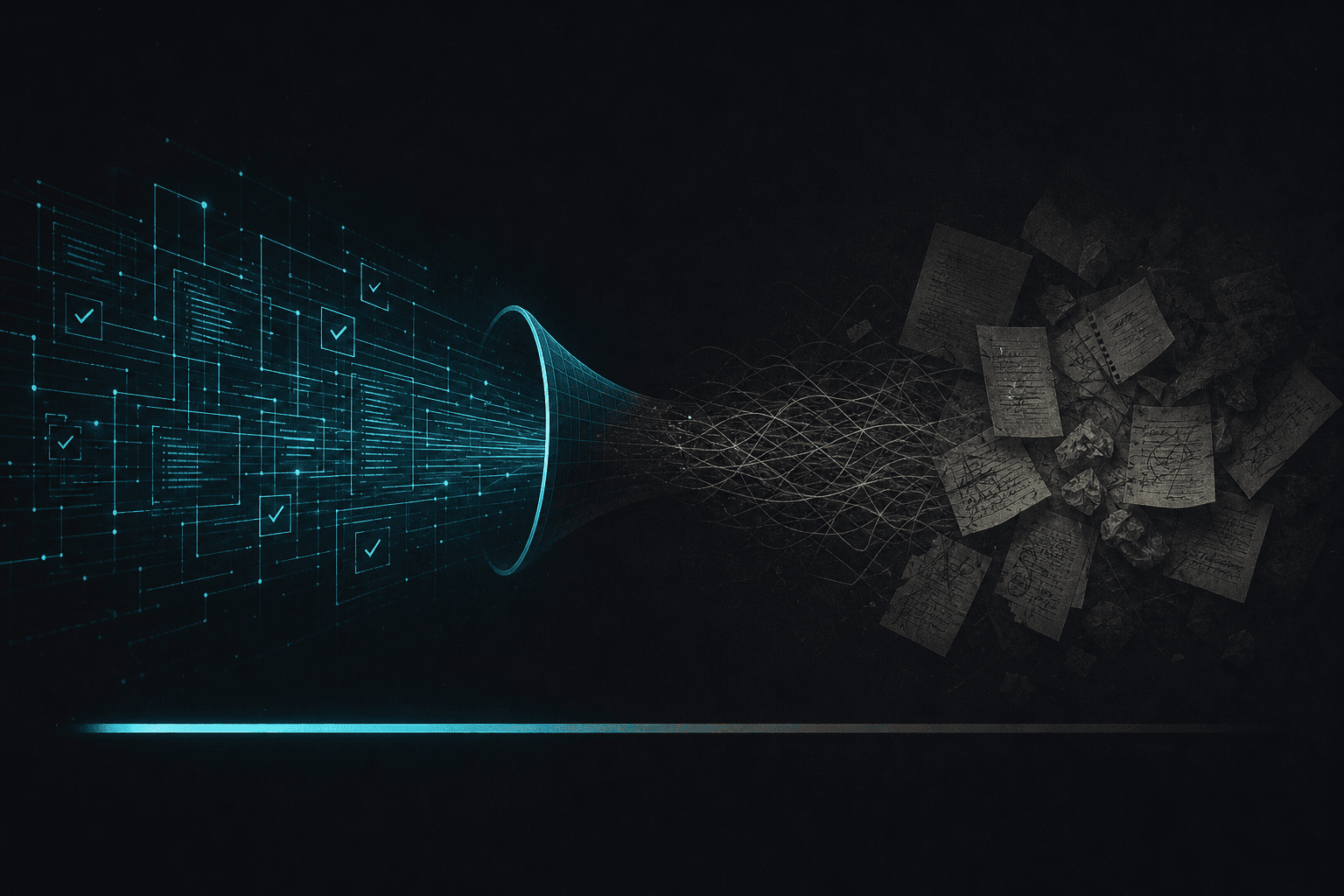
Same model. Same silicon. Different domain. In one place the agent gets a compiler. In the other it gets a meeting.
That is the story. And once you see it, the last three years of enterprise AI look different. It was not a domain-readiness contest. It was a grader contest. Software got agents first because software is the only domain whose work came with a free machine-checkable grader. Every other domain has to build one. Some are; most are still buying seats.
The four preconditions were three multipliers hiding a law
For most of 2025 the accepted framing was that four preconditions had to line up before a domain could sustain agentic work:
- Text-native versioned artifacts. The work has to live in files, in git, in something an agent can read, diff, and revise.
- Composable tools. APIs, CLIs, MCP servers — surfaces an agent can call without a human in the loop.
- Practitioner-builders. People who both do the domain work and can write the loop that automates a piece of it.
- Machine-checkable ground truth. Some test, some checker, some deterministic oracle that grades whether the agent's work was actually right.
All four are real. Software has all four. That framing predicts what we see. But it predicts it the way "cars need engines, wheels, fuel, and a driver" predicts why some cars move — technically correct, useless as a design principle.
The refactoring that matters is this: the fourth precondition is a law, and the first three are multipliers. Machine-checkable ground truth is the leverage. Text-native artifacts, composable tools, and practitioner-builders only compound because ground truth is free. Take away the law and the multipliers stop multiplying.
Call it one law, three multipliers. It is going to be the spine of this whole series. Where the law is free — free as in "the grader runs on every keystroke" — agents ship. Where the law is expensive, autonomy compresses to advisory. Where the law does not exist yet, whatever the vendor is selling is a chat surface with a change-management problem attached.
The law: your work must be able to grade itself
Compilers. Type checkers. Unit tests. Integration suites. Fuzzers. CI. Linters. git diff. git blame.
Software engineering is the only professional discipline in which the default artifact of the work — source code — is continuously and mechanically evaluated against an executable specification. Every save fires a check. Every commit fires a build. Every PR fires a suite. The oracle is free, deterministic, and available at the speed of the CPU.
That is what Mistral reported, in the most concentrated form we have seen, at the end of last month. Leanstral 1.5 — a 119B open-weight Lean 4 proof agent, 6.5B active — solved 587 of 672 PutnamBench problems at roughly $4 per problem, versus $300-plus per problem for frontier brute force, on Mistral's own vendor-reported benchmark. That is a ~75x cost advantage for a smaller model (Mistral, 2026-06-30). The mechanism is not clever prompting. The mechanism is that the Lean compiler is the ground truth. The agentic loop tries a proof, the compiler says yes or no in milliseconds, the agent tries again. Verification is free. The tuned open model wins on cost because it does not have to be smart — it has to be persistent.
Bridgewater and Thinking Machines showed the same shape one week later. A tuned Qwen3-235B hits 84.7% on internal finance-task evals against 78.2% for the best frontier model, at 13.8x lower cost (Bridgewater test, 2026-07-04; vendor-reported, single company eval). The reason the fine-tune is rational is not that the base model got better. It is that Bridgewater built the eval. The eval is the asset. Once you can grade the work, you can tune down the model.
The pattern is not "big model beats small model." It is "cheap grader beats expensive model." That is the law.
Now compare law to Harvey's benchmark. Harvey did the right thing — they built the hardest publicly-scored legal benchmark in the industry and they ran the frontier through it. And in May 2026 the frontier ceiling on it was 10.4% all-pass. A partner reads the answer and marks it against a rubric. Every score is an hour of a lawyer. The grader is partner-track time — slow and expensive by construction.
That is why software has agents and law has anecdotes. It is not the difficulty of the underlying task. It is the difficulty of grading the answer.
The three multipliers, in order of dependence
Once ground truth is free, the other three preconditions convert into leverage.
Text-native versioned artifacts. The work has to be something you can diff. Software's answer is source code and git. Every meaningful change is a versioned reviewable object. Claude Code v2.1.198, shipped a week ago, made this literal: background agents auto-commit, push, and open draft PRs by default (Claude Code 2.1.198, 2026-07-01). Anthropic is not the only vendor doing this — GitHub, Cursor, Codex, Devin all default to the same shape. The reason is not that engineers love git. It is that git is the only surface that lets an autonomous system make a change and hand the change back for approval without a human being in the loop during the change itself.
Git wasn't a developer tool. It was an autonomy interface. Nobody noticed until an agent was on the other end of it.
Every domain that wants agents needs its version of this. Legal is building it: anthropics/claude-for-legal is a public git repo of legal workflows, plugins, and connector patterns — an actual attempt at putting law under version control. Finance is building it inside Morgan Stanley, Bridgewater, and every bank that has ever written a control test. But most non-software domains still treat the artifact as a document, not a versioned commit. That is a legibility bug you can measure in latency to autonomy.
Composable tools. The agent needs surfaces it can call. Software got MCP first, but it got function-calling, CLIs, and REST years before that. The relevant 2026 datapoint is not the SDK — it is that composable tools have collapsed onto a procurement standard. Microsoft's Service Agent went GA on 2026-06-30 with an MCP server exposing 70+ tools. Google's remote MCP for Gemini Enterprise landed the next day. Adobe's CX skills went GA inside Claude Enterprise and M365 Copilot. Workday Agent-Ready Tools shipped early June. The tool layer is now a procurement boundary, not a feature. Part 2 of this series is going to spend a lot of time on that shift, because the tools are how AGENTS.md becomes real — but for Part 1 the point is narrower: composable tools are how the multiplier works, but they only multiply where a grader can tell you whether the tool call was correct. Otherwise you are just running scripts faster.
Practitioner-builders. The person who does the domain work also builds the loop. Software has this by construction — engineers already write code. Cursor and Codex made it self-reinforcing. Coinbase reports 75% of PRs are agent-created, with idea-to-production dropping from 20 days to under two. Faire reports 2,000+ autonomous runs per week and PR throughput roughly doubling. Amplitude reports 3x weekly production commits with 60-70% of low-risk PRs merged without extra dev work (Cursor customer case studies, W25, 2026-06-20; vendor-reported / customer case study). Those are the endpoint numbers — the state other domains would like to be in.
They are also vendor-reported and worth reading with the appropriate discount. But the shape is unambiguous: where practitioners can build, and where those builds have graders, the rate of change moves inside the domain. It stops being a project. It starts being a habit. This is the endpoint of the leverage ladder — Chat, Cowork, Build, Automate — that took me eighteen months to climb one rung at a time. The rung between "Build" and "Automate" is exactly the rung where machine-checkable verification appears. That is not a coincidence.
Practitioner-builders scale only where they have a compiler to argue with. Take away the compiler and the practitioner-builder is a slide deck with strong opinions.
The verification cost gradient
Words do not carry this. The picture does.
The verification cost gradient
Same model. Same silicon. Different domain.
The question is not whether the agent is capable. The question is what it costs to know it was right.
Software
The grader is free and runs on every keystroke.
The grader
Compiler + tests + CI + diff
Dated evidence
Software got agents first because software is the only domain whose work comes with a free grader. Everything to the right pays for its receipts in people, methodology, or time — or does not verify at all, which is worse.
Read left to right, this is not a static readiness scorecard. It is a verification cost gradient. Software's grader runs at the speed of a CPU, for a cost approaching zero. Formal science's grader runs at the speed of a proof engine or a wet-lab replicate — real but slower. Finance's grader is the reconciliation-to-source loop, which exists per workflow and now, in some firms, exists as an internal eval suite the way engineering shops keep unit tests. Legal's grader is a lawyer with a rubric. Sales' grader is the quarter, and by the time the quarter ends the model has been replaced.
Two rows are marked low observability for honesty. Supply chain has real ground truth inside constraint solvers and simulation environments, but the public evidence base in 2026 is thin. HR produced no application-layer product event with a graded outcome in eleven consecutive weeks of industry coverage. Absence of evidence is itself weak evidence. Do not read the right end of this chart as definitive incapability. Read it as evidence about who is publishing, who is graded, and who is still selling assistants.
The predictive claim: the domain that moves left on this gradient the fastest is the domain that will absorb agentic work fastest. Not the domain with the shiniest chat UI. Not the domain with the largest F500 pilot count. The domain that builds its grader.
Steelman the gap, then close it
The best objection to this whole framing is that software itself has not crossed the line either. Every serious agent-coding product — Claude Code, Cursor, Codex, Devin — stops at draft PRs by default. The W27 industry roundup made this explicit: even after the tooling surge of June 2026, the auto-merge line was not crossed. A human still clicks approve.
That is real. Concede it aggressively.
But concede it precisely: verification compresses the work, not the accountability. The human still owns the merge, still owns the incident, still owns the on-call page. What verification did was collapse a five-day change into a five-minute review. The engineer's job did not disappear. It moved up the stack — from authoring the change to authoring the acceptance criteria and reviewing the diff. That is what "verification-bounded autonomy" actually looks like on the ground.
Morgan Stanley's FIXR reconciliation program is the same pattern in a different domain. P&L reconciliation went from six hours per book to two-to-three, saving roughly 1,500 controller-hours per week across ~100 controllers (reporting on FIXR, 2026-07-01; grade 2-3, verify against primary). The most striking finding: the gains came from making the agents less autonomous, not more. The team decomposed the workflow until every step was human-verifiable, then let the agent run the verifiable steps.
That is what the FIXR pattern actually teaches — verification is a discovery function. You do not sprinkle verification on a workflow at the end. You break the workflow apart to find the pieces the agent can prove, and you leave the pieces it cannot to the human. Autonomy without verification is just error at machine speed. Autonomy with verification is a compressed loop that keeps the receipts.
Which is why Devin's Security Swarm design lands the way it does. Every finding is reproduced in an isolated sandbox against a running build before it hits a human's queue: 36 of 50 real CVE-linked vulnerabilities found, 30% lower cost per finding (Cognition, 2026-07-01; vendor eval). The sandbox is the grader. The grader is what makes the queue trustworthy.
If you have been reading the Modes of the LLM OS — the way the loop is the machine in Agent Mode — this is the material connection. The loop only works when there is something in the loop that can say "not yet." The compiler says it. The unit test says it. FIXR says it. Legal's answer is that a partner says it. Different loops. Different tempos. Different costs.
What breaks if you get this wrong
Two failure modes dominate the enterprise deployments I see in mid-2026.
Failure mode one: buying agentic capability without buying the grader. A F500 signs a seven-figure contract for an "agentic legal platform" or an "agentic finance copilot." The agent is real. The tool integrations work. The context is loaded. There is no eval. There is no domain benchmark. There is no reconciliation-to-source loop with a pass/fail count. Nine months later the pilot report says the outputs were "helpful" and "well-received" and no one can produce a graph.
That deployment did not fail because the model was weak. It failed because the buyer did not know that in 2026 the model is not the deliverable. The grader is the deliverable. Everything else is a chat interface with a fancier login.
Failure mode two: forcing autonomy where verification does not exist. A team wires an agent into a workflow that has no unit test — sales prospecting, HR intake, general knowledge work — and then measures success by "seats using it." Adoption goes up. Attribution goes nowhere. When something goes wrong six months in, no one can say whether the agent's decision was actually wrong, only that the outcome was bad. You cannot debug what you did not verify.
Both failures share a root cause: they treated agentic capability as a general-purpose good and verification as a downstream concern. Part 3 of this series will make the pricing consequence explicit — margin follows verification — but the operating consequence is already visible today: without a grader, the agent is a demo that gets published as a product.
That is why the stochastic-core, deterministic-shell frame keeps working. The core reasons probabilistically. The shell is what turns probability into accountable output. And the shell only holds if you built the tests.
Predictions on the record
Three dated claims, each with a measurable criterion and its supporting evidence.
-
By 2027-06-30, at least one non-software domain publishes a benchmark graded by deterministic reference execution — not human juries — and an agent scores ≥60%. Most likely lanes: finance reconciliation, healthcare coding, formal contract fields. Rationale: Bridgewater/Qwen3-235B hitting 84.7% on internal finance evals (2026-07-04) is the confirmatory shape one lane off software; the FIXR decomposition (2026-07-01) is the workflow-level analog. If it holds, the "grader gap" starts closing in finance first.
-
By 2026-12-31, at least two major coding-agent products ship a GA "no-human-required" path for a bounded class of changes — auto-merge with policy gates. The precondition is already in production: Claude Code auto-commits and opens draft PRs by default (2026-07-01); GitHub session limits stream to SIEM/Purview; the only missing piece is the policy gate that authorizes the merge. Coinbase and Faire's throughput data (Cursor, 2026-06-20; vendor-reported) creates commercial pressure to formalize the last step.
-
By 2027-12-31, the frontier-vs-tuned-open-model gap on SWE-bench Verified shrinks to ≤3 points, and the same closure appears in at least one other domain with deterministic evals. Rationale: Leanstral 1.5's 75x cost advantage on PutnamBench (2026-06-30) is not a Lean 4 special case; it is what happens whenever verification is free and a smaller model can iterate. As soon as another domain has a real grader, the same convergence should show up.
If any of these misses by the date named, this framing is wrong somewhere and I owe you a revision.
What to do on Monday
Three moves. In order.
-
Name your compiler for your top three agentic workflows. For each candidate workflow — a reconciliation, a memo, a case summary, a supplier decision, a spend approval — write down in one sentence what the grader is. "The invoice matches the PO within tolerance." "The clause exists in the standard library." "The forecast reconciles to the source system." If you cannot write that sentence, you do not have a workflow for agents yet. You have a chat surface.
-
Publish the grader before you buy the agent. Do not sign a seven-figure agentic platform contract without first funding a small internal eval suite scoped to the workflow the agent is supposed to do. Six weeks. One engineer. One domain expert. One dashboard with a pass rate on it. If your vendor cannot survive being scored, they cannot survive being deployed either.
-
Move one workflow from "reviewed by a human" to "verified by a check." Pick the smallest possible one. A field validation. A citation checker. A reconciliation. Wire it into your definition of done. That is the first vertebra of your domain's CI, and every subsequent vertebra is cheaper than the last.
You are not trying to become an engineering shop. You are trying to give your work receipts. That is what the Build and Automate postures actually require in 2026 — not more model, not more seats, but a grader that runs while everyone is asleep.
Next week, in Part 2, the argument moves from "why software" to "what every domain needs" — the five translations from human-legible artifacts to agent-legible interfaces, why AGENTS.md is the right name and the wrong mental model, and why the context-layer boom in 2026 is producing a lot of very expensive furniture. The takeaway holds either way: engineers didn't get agents first because they're special. They got them first because their work already came with receipts.
Operate. Publish. Teach.